Battlezone retro arcade game review
Battlezone: The Game That Brought 3D to the Arcades
When Atari released Battlezone in November 1980, it marked a watershed moment in arcade gaming. Here was a game that placed you inside a tank, navigating a three-dimensional battlefield filled with enemy vehicles and geometric obstacles. Developer Ed Rotberg and his team had created something genuinely novel—the first commercially successful first-person 3D arcade game. With around 15,000 cabinets sold, Battlezone proved that players were ready for more sophisticated spatial gameplay, even if it meant wrestling with unfamiliar controls and a completely new way of experiencing a video game.
The Technology Behind the Wireframes
Vector Graphics and the Math Box
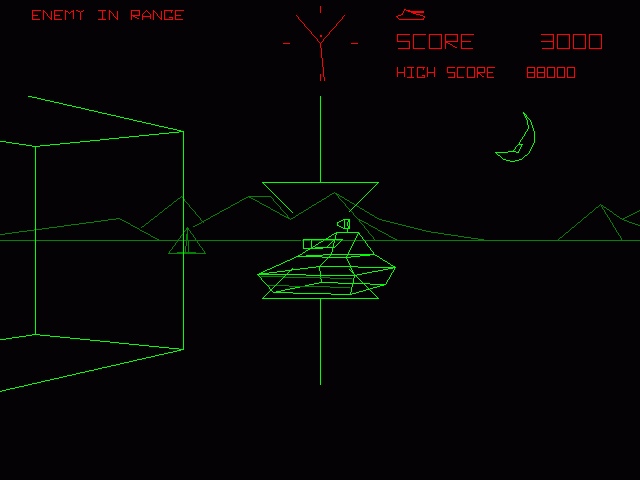
Battlezone used the same vector graphics technology that powered Asteroids, later refined in classics like Tempest and the Star Wars arcade game. Unlike the raster displays found in most games—which built images from thousands of tiny dots—vector displays drew lines directly onto the screen using electron beams. The cathode ray traced paths across the phosphor coating, which glowed briefly before fading and requiring a redraw. This technical limitation created the characteristic flicker you’d notice if you stared too long, and it also dictated the wireframe aesthetic that became synonymous with early 3D gaming.
The computational challenge was immense for 1980 hardware. Battlezone required three separate microprocessors working in concert: a MOS Technology 6502 handled the game logic, a custom processor managed the display, and a specialized “Math Box” built from AMD Am2901 bit-slice processors crunched the numbers for perspective rendering. This Math Box, designed by Jed Margolin and Mike Albaugh, was the key to making real-time 3D feasible. The team simplified the problem by restricting movement to a horizontal plane, reducing the transformation matrix from 4×4 to 2×2—a clever optimization that made the calculations manageable without sacrificing the sense of three-dimensional space.
Why Everything Was Green
The distinctive green wireframes weren’t just an aesthetic choice. Battlezone used an Electrohome vector monitor with green phosphor because it had better persistence than other colors, which helped reduce the flicker inherent to vector displays. Some cabinets added a colored plastic overlay—green for the battlefield below, red for the radar and status information above—though this was purely cosmetic.
According to Ed Rotberg’s account in IEEE Spectrum, much of the development focused on optimization. He worked closely with graphic designer Roger Hector to minimize vertices and lines for each object, as the three processors struggled to maintain playable frame rates with complex scenes. Rather than attempting proper hidden-line removal (which would have been computationally prohibitive), they used distance-based brightness—objects dimmed as they moved away—which was simpler to calculate and still conveyed depth effectively.
Creating a World You Could Drive Through
True 3D Navigation
While Asteroids gave you a two-dimensional playing field, Battlezone constructed an actual three-dimensional environment. Objects existed in simulated depth, and the game continuously recalculated their positions relative to your tank’s location and orientation. Parallax scrolling enhanced the illusion—foreground pyramids and blocks moved across your view faster than the distant mountains on the horizon, creating a convincing sense of depth and distance.
Understanding what this meant in 1980 requires context. Most arcade games were strictly two-dimensional. Home computers like the Apple II and Atari 800 couldn’t handle real-time 3D graphics at all. Genuine three-dimensional rendering was confined to research laboratories and military applications—systems that cost hundreds of thousands of dollars and filled entire rooms. Battlezone demonstrated that with careful optimization and smart constraints, you could create navigable 3D environments on consumer hardware.
How It Compared to Other Games
A few earlier games had experimented with pseudo-3D effects. Tail Gunner (1979) used scaling sprites that grew as they approached, creating a basic depth illusion. The PLATO system had Panther, a first-person tank simulation, though Rotberg stated he hadn’t played it before developing Battlezone. What set Battlezone apart was the continuous 3D environment where you could move freely in any direction, rather than following predetermined paths or fixed viewing angles.
Even years later, home computer versions struggled to match the arcade’s performance. Encounter (1983) for the Commodore 64 offered similar wireframe 3D graphics but ran at a fraction of Battlezone’s frame rate, making it feel sluggish by comparison.
The Dual-Stick Controls and Periscope View
Learning to Drive a Tank
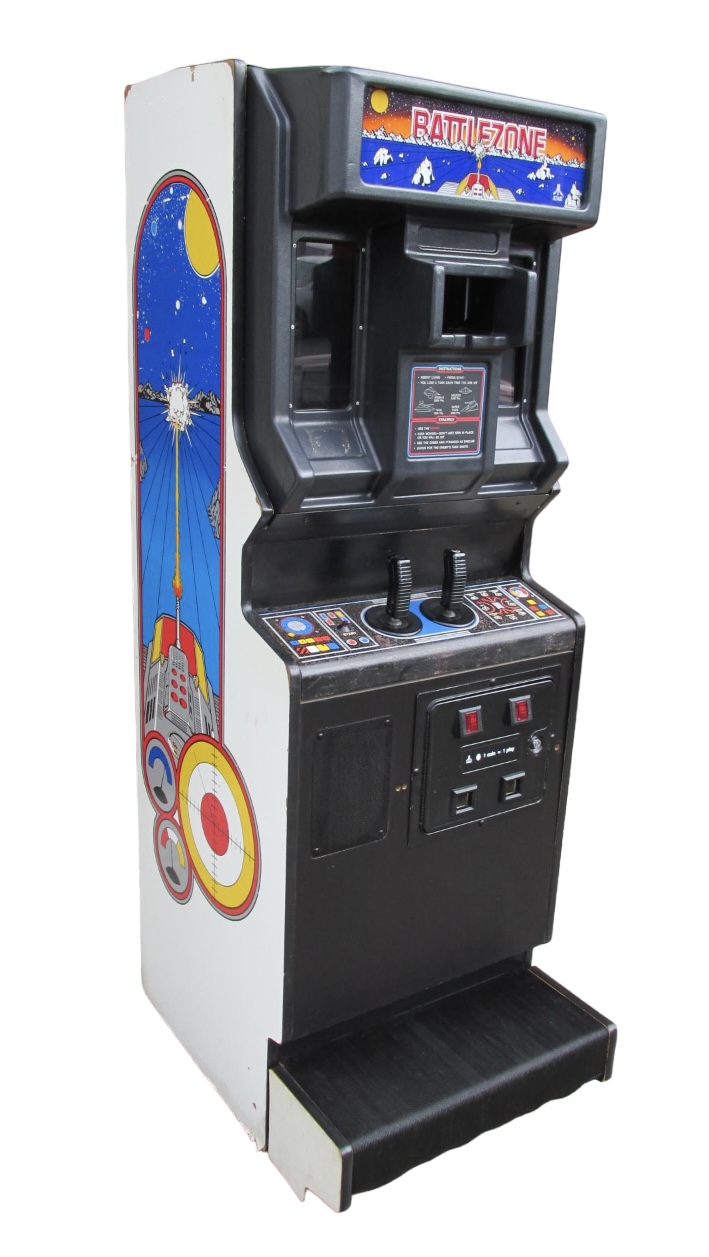
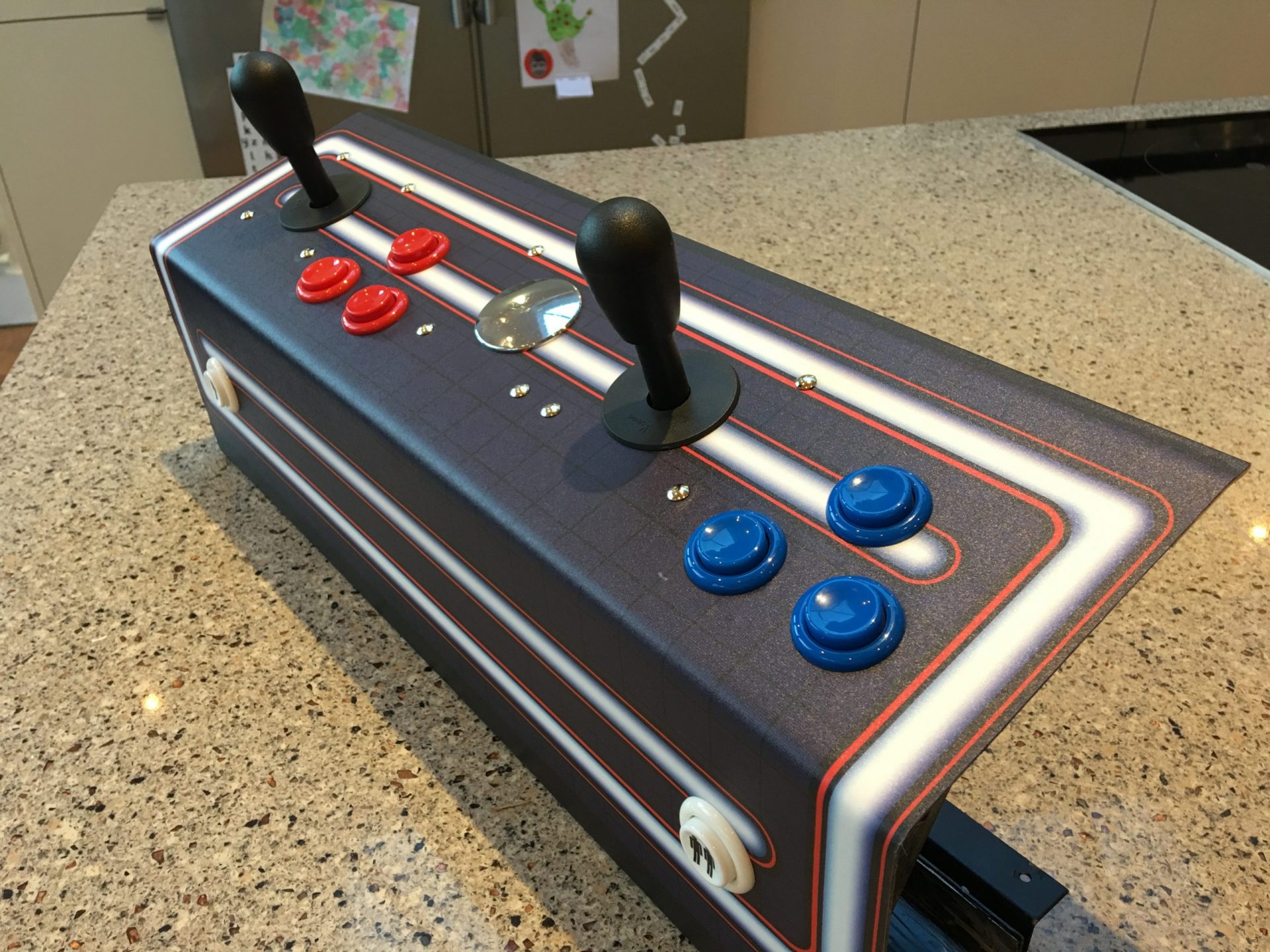
Battlezone’s control system was unlike anything in the arcades. Two parallel joysticks, each controlling one of your tank’s tracks—push both forward to move straight ahead, push them in opposite directions to spin in place, use differential pressure to turn. It felt strange initially, but once you understood it, the system made perfect sense. This was how tracked vehicles actually steered, and it gave you precise control over positioning, which was crucial given the tactical nature of the gameplay.
The cabinet’s periscope viewing hood served multiple purposes. It blocked out the arcade’s ambient light and noise, creating a more immersive environment. It restricted your field of view to match actual tank periscope limitations. And it partially concealed the vector display’s flicker from direct viewing, as the restricted aperture made the screen refresh less noticeable. The design worked—for a few minutes at a time, you genuinely felt like you were operating a tank.
Cabinet Variations
Atari produced several cabinet configurations. The original upright with its periscope created the most immersive experience but had drawbacks—it limited spectator visibility (reducing the game’s draw for new players) and raised hygiene concerns as players pressed their faces against the same surface. A modified upright eliminated the periscope, raising the monitor to a conventional height. A smaller cabaret version with an angled display also appeared. Atari developed a cocktail table prototype but never put it into production.
Strategic Tank Combat
Tactics Over Reflexes
Battlezone wasn’t about rapid-fire shooting. The deliberate pace of tank movement meant you had to think several moves ahead, using the geometric obstacles as cover while maneuvering for clean shots. Your radar showed enemy locations and distances, letting you track threats beyond your immediate view. Combat became a tactical exercise in positioning—both you and enemy tanks rotating to achieve targeting angles, with victory going to whoever lined up their shot first. Fire too early and you’d miss; hesitate too long and incoming fire would crack your screen.
The enemy variety kept things interesting. Standard tanks behaved much like yours, maneuvering and firing with similar capabilities. Super tanks moved faster and absorbed more damage. UFOs flew above the terrain obstacles that provided cover for ground vehicles, forcing different tactics. Guided missiles came at you fast, demanding immediate evasive action. Each enemy type required you to adjust your approach.
The Development Story
From Prototype to Production
Battlezone began when Ed Rotberg got access to one of Atari’s early vector display development kits. Morgan Hoff championed the tank simulation concept during internal brainstorming sessions and became the project leader. The development took roughly 15 months from initial design to production. During this time, the game went through several name changes—early prototypes were called “Future Tank” and “Moon Tank” before settling on Battlezone by the time it reached the AMOA trade show.
Development had its informal moments. Programmer Owen Rubin kept pestering Rotberg to make the background volcano erupt. When Rotberg said he was too busy with core gameplay, Rubin wrote the volcanic eruption code himself and left it on Rotberg’s desk. Rotberg spent an afternoon integrating it—which is how Battlezone got one of its most memorable visual flourishes.
The Military Simulator That Almost Wasn’t
Shortly after Battlezone hit arcades, a consulting group of retired Army generals approached Atari about creating a modified version to train gunners on the M2 Bradley Infantry Fighting Vehicle. Ed Rotberg initially refused to work on it due to his opposition to military applications of gaming technology. Management eventually convinced him by promising he’d never have to work on military projects again.
The Bradley Trainer, as it became known, differed substantially from the arcade game. You controlled only the weapon systems—now capable of aiming vertically—while the vehicle remained stationary. The armament expanded to include machine guns, armor-piercing rounds, incendiary shells, and TOW missiles that required you to maintain target lock after firing. Helicopters joined the enemy roster. The control system replicated the actual Bradley’s gunner station, and Atari later repurposed this controller design for their Star Wars arcade game. Only two Bradley Trainers were built; the Army received one (now lost), while the second survived in a private collection after being found by a dumpster at Midway Games.
Commercial Success and Critical Reception
How It Performed
Battlezone sold approximately 15,000 arcade cabinets—a respectable figure, though smaller than Asteroids’ 70,000+ units. The timing was excellent; the game launched during the peak years of the arcade boom. In 1980, U.S. arcade video games generated $2.8 billion in revenue, and 1981 would see this climb to around $5 billion. The game earned an Honorable Mention for “Best Commercial Arcade Game” at the 1982 Third Annual Arkie Awards.
Contemporary publications praised the technical achievement. Electronic Games called the graphics “revolutionary,” while Play Meter highlighted the earning potential for arcade operators. The game’s innovative presentation became a talking point at industry shows, and players who experienced it often tried describing the 3D effect to friends who hadn’t yet played.
Influence on Gaming
Battlezone’s impact extended well beyond its sales figures. It demonstrated that first-person 3D graphics could work in consumer entertainment, establishing design patterns that later first-person games would build upon. The combination of immersive viewpoint, spatial navigation, and tactical gameplay created a template that developers would refine for decades. While calling it the first first-person shooter requires some caveats—other early 3D games developed in parallel—Battlezone certainly demonstrated the potential of the first-person perspective for action gaming.
The game is sometimes cited as an early virtual reality experience, and there’s truth to this. The periscope viewing system, first-person perspective, and tank-track controls combined to create an unusually immersive experience for 1980. While “virtual reality” wouldn’t gain its modern meaning until later in the decade, Battlezone anticipated many VR principles: restricted field of view, position-based viewing, and controls that simulated physical actions rather than abstract inputs.
Bringing Battlezone Home
The Atari 2600 Version
The 2600 port, released in 1983, required substantial compromises. The console’s TIA chip couldn’t produce vector graphics, so the entire game was reimplemented using raster graphics. The perspective shifted from first-person to third-person, with your tank visible on screen. Controls used both joystick and paddle in combination—an unconventional setup that tried to preserve some feel of the dual-stick control. Despite these limitations, the port captured core elements of the gameplay reasonably well given the hardware constraints.
Computer Ports
Throughout the 1980s, Battlezone appeared on virtually every home computer platform. The DOS version for IBM PC compatibles came closest to the arcade original in visual fidelity. The Commodore 64 version added color and enhanced audio, though it used raster graphics rather than true vectors. Ports appeared for Apple II, Atari 8-bit computers, Atari ST, ZX Spectrum, and VIC-20, each adapted to its platform’s capabilities and limitations.
Quality varied considerably. Atari’s own 8-bit computer versions naturally achieved the closest approximations. The ZX Spectrum port struggled with the platform’s limited memory and processing power. None could perfectly replicate the arcade’s specialized vector hardware—these were approximations rather than exact translations. An Atari 5200 port was in development but got cancelled when Jack Tramiel took over Atari’s consumer division in 1984.
Modern Availability
Battlezone has remained accessible through various compilation releases. The Atari Lynx got Battlezone 2000 in 1995, which added filled polygon graphics as an option. Microsoft Arcade for Windows (1993) included an emulated version. The Game Boy received a Battlezone/Breakout combo cartridge in 1996.
More recently, the 2008 Xbox Live Arcade version (by Stainless Games) updated the graphics to 1080i and added online multiplayer with deathmatch and capture-the-flag modes. Atari’s modern compilations—Atari Vault on Steam and Atari 50—provide access to the original arcade version through emulation. These releases let contemporary players experience the game, though without the specialized cabinet and controls, some of the original’s immersive qualities are diminished.
The Technical Legacy
Foundations for Future 3D Games
Battlezone established practical solutions to challenges that would remain relevant throughout 3D gaming’s evolution. The optimization strategies—efficient data structures, simplified geometry, strategic elimination of expensive features—were born from 1980s hardware constraints but continued to inform 3D development as technology advanced. The mathematical techniques in the Math Box (matrix transformations for perspective projection, coordinate system conversions, efficient rendering pipelines) became standard components of 3D graphics systems.
The design philosophy also mattered. Rather than attempting photorealism (which was technologically impossible), Battlezone used abstract geometric forms that clearly communicated spatial relationships. This approach—prioritizing functional clarity over visual detail—has remained relevant, particularly in genres where spatial awareness is critical.
A Milestone in Gaming History
Battlezone holds an important place in video game history as one of the earliest commercially successful real-time 3D graphics implementations. While not absolutely the first 3D game—earlier experiments existed on mainframe systems—it was among the first to prove that such technology could work in arcade environments and generate substantial revenue. It showed that players would engage with complex spatial interfaces and that the extra development costs could be justified through market success.
In the context of first-person shooter development, Battlezone established several conventions: heads-up displays for status information, radar-based threat detection, and environment-based tactical gameplay. The direct influence on later FPS titles is difficult to trace definitively—many design elements evolved independently across multiple games—but Battlezone demonstrated the potential of the first-person perspective for action gaming, a contribution recognized by gaming historians and industry analysts.
Playing Battlezone Today
Finding Original Hardware
Original Battlezone cabinets remain available through the vintage arcade market, though working examples are increasingly scarce and valuable. The Video Arcade Preservation Society’s census shows approximately 623 active collectors own Battlezone machines. The game ranks highly in demand—93 out of 100 on popularity metrics. Prices vary substantially based on cabinet condition, version (periscope versus open-face), and the functionality of the vector display, which requires specialized expertise to maintain.
If you can find a working unit at a retro arcade or gaming museum, it’s worth experiencing. The periscope, dual-stick controls, and vector display create something that emulation can’t fully replicate.
Emulation Options
MAME provides accurate emulation of the original arcade hardware, reproducing the game’s behavior with high fidelity. It supports dual joystick configurations, letting you approximate the original controls on modern hardware. The vector display emulation is faithful, though the phosphor glow and flicker are simulated rather than authentic physical phenomena. MAME’s cross-platform availability and accuracy make it the preferred option for experiencing Battlezone without original hardware.
Official releases provide sanctioned access. Atari 50: The Anniversary Celebration (2022) includes the original arcade game with historical context and development documentation. Atari Vault (Steam, 2016) also features Battlezone. These releases typically offer save states, display filters, and control customization, though the core emulation uses similar technology to MAME.
Modern VR Versions
Rebellion Developments acquired the Battlezone IP from Atari’s bankruptcy proceedings in 2013 and released a VR game titled Battlezone in 2016 for PlayStation VR, with subsequent PC VR and console ports. This modern interpretation reimagines rather than recreates the original, incorporating contemporary gameplay conventions and filled-polygon graphics while maintaining the geometric aesthetic. For the historical experience rather than modern reinterpretations, stick with emulated versions of the original.
Final Assessment
Battlezone’s significance lies in what it proved possible. The game showed that complex 3D environments could be rendered in real-time on consumer hardware through intelligent optimization and smart constraints. The unconventional control system worked because it enhanced both thematic coherence and gameplay depth. The tactical, positioning-focused gameplay demonstrated that arcade games could engage players through strategic thinking alongside reflexive action.
The legacy extends beyond commercial success to influence on subsequent 3D game development and demonstration of principles that remain relevant today. Modern 3D games have vastly exceeded Battlezone’s technical capabilities, but the fundamental challenges it addressed—creating spatial presence, managing computational resources, designing effective 3D interfaces—continue to inform game development. Battlezone helped establish that three-dimensional gameplay could engage consumers and generate sustainable returns, setting a trajectory that would ultimately lead to 3D graphics becoming the dominant paradigm in video games.
More like this
BAS Arcade Cabinet Restoration - Part 2
Part 2 of my BAS Arcade Cabinet restoration, where I renovate the coin doors, marquee and metalwork of this iconic British JAMMA machine
The Arcade Shed Build - Part 1
Follow the build of an arcade shed at the bottom of my garden, using a standard wooden shed with extra insulation for use all year round.
Arcade Cabinet Restoration
Follow my restoration of this old BAS Arcade cabinet. In the first update I tackle the monitor, the woodwork, the control panel and controls
Comments