Top 10 ZX Spectrum Games
· Updated · ZX Spectrum
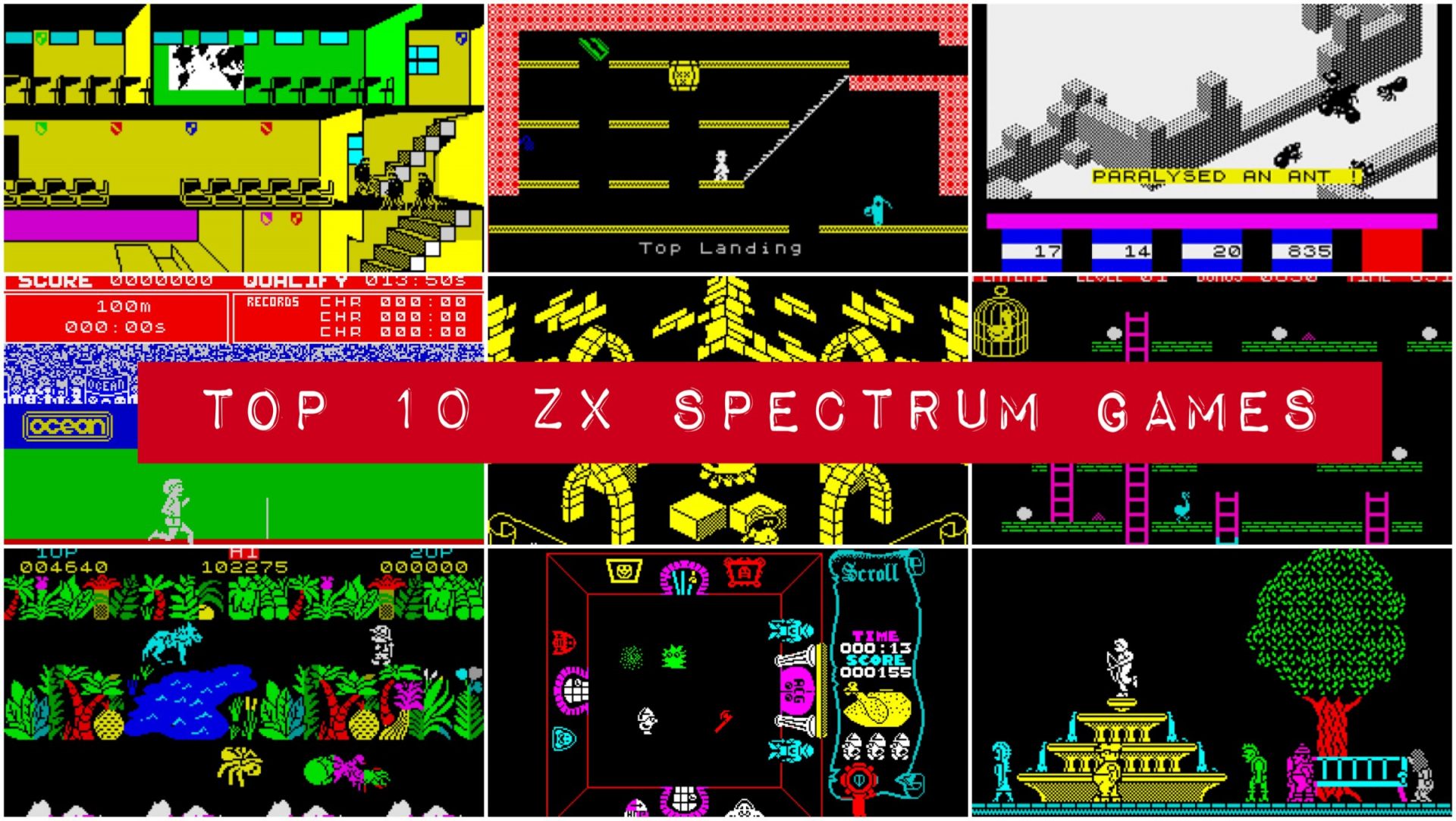
Top 10 Spectrum Games: The Best ZX Spectrum Games Ever!
Games every ZX Spectrum owner should play
Every Spectrum owner will have had their own personal favourites on Sinclair’s popular home computer, and I have drawn up a list of what I believe to be the best. My Spectrum Top 10 is based on my experiences of innovative games that, even 40 years later, spark fond memories of that fantastic little machine with the rubber keys.
Back in the playground, the home computer wars were fierce. Commodore 64 owners bragged about their SID chip and smooth scrolling, BBC Micro owners pointed smugly at their school-approved machine, but we Speccy owners had the last laugh: a computer our parents could actually afford, and a library of games so vast that there was always something new to load on a Saturday morning.
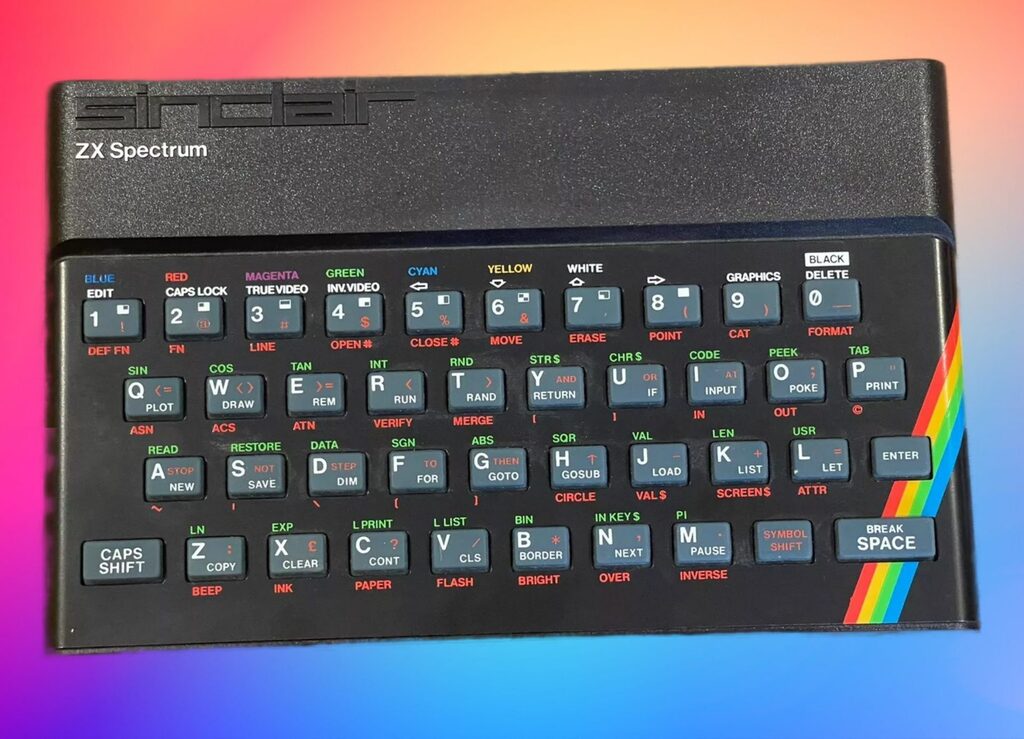 The colourful ZX Spectrum
You could claim that I have made some notable exclusions, such as footballing classic Match Day, perennial favourite 3D Deathchase, and the various games featuring Codemasters’ egg-shaped mascot Dizzy. All I can say is that this is my list, and I have my reasons for every game included here. Some may surprise you, not least the number of times one particular developer appears.
Why the ZX Spectrum was the people’s computer
When Sinclair Research launched the ZX Spectrum in April 1982, the 16K model cost £125 and the 48K version £175, a fraction of the price of its rivals. That price put a real computer into hundreds of thousands of British bedrooms, and a generation of kids learned to program on it. Many of those kids went on to write the games on this list, often working alone or in pairs, and some of the studios they founded are still household names today.
The hardware was famously simple. The Spectrum had no sound chip, just a beeper, and its graphics were limited by “colour clash”, where each 8×8 block of the screen could only show two colours at once. Rather than holding developers back, those limits forced them to be inventive, and the result was a library of games with a character all of their own: bold, colourful, frequently bizarre and very, very British.
I have included a mix of 16k and 48k Spectrum games, as I owned both versions, and early arcade-style titles that fitted into the smaller memory could be just as good as the (relatively) memory-hungry ones. Remember this was a time when there were no hard drives. Every game had to be loaded from tape (or sometimes Microdrive) directly into memory whenever you wanted to play, accompanied by that unforgettable screech and the flickering stripes in the border.
So after much deliberation, here are my Top 10 Spectrum games…
10 – Jet Set Willy
Software Projects – 1984
Every Spectrum owner will have played one of Matthew Smith’s classic platformers starring Miner Willy. The first game, Manic Miner, was a sensation, and its sequel, Jet Set Willy, was even better.
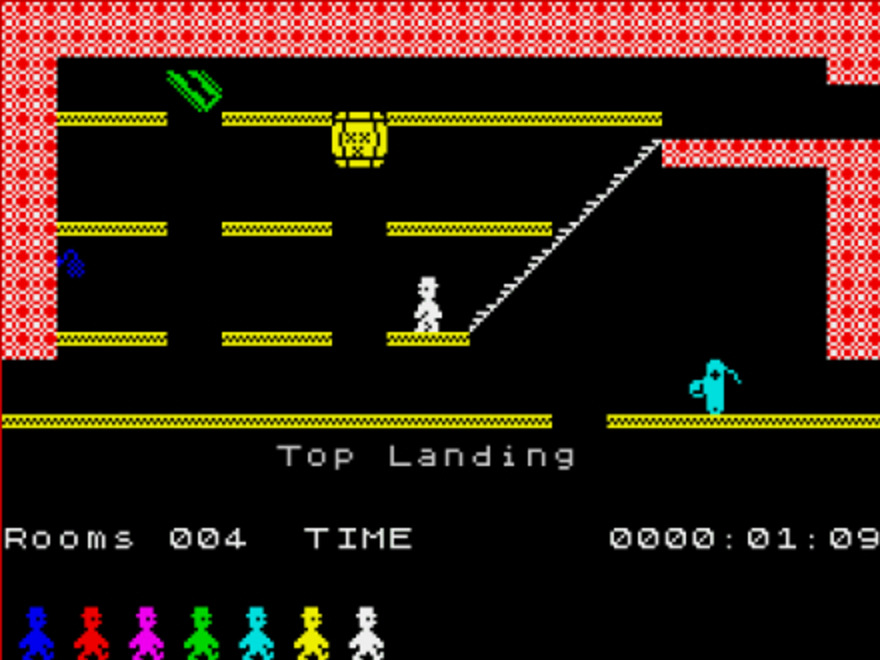 Jet Set Willy navigates the Landing
Having made his fortune in the first game, Miner Willy has bought a huge mansion and thrown the mother of all parties. Before he can go to bed, Maria the housekeeper insists that he tidies up, which means exploring the many rooms of the mansion and collecting every misplaced object. Jet Set Willy improved on the linear, level-by-level structure of the first game by allowing free movement between rooms, creating a sprawling mansion of around 60 rooms with wonderfully surreal names like “The Off Licence” and “We must perform a Quirkafleeg”.
The first really good platformers on the Spectrum, these games featured many tricky hazards, including conveyor belts, crumbling walkways and devious enemies, and required some pixel-perfect jumping. Jet Set Willy was also famous for its bugs: a fault in one room made the game impossible to finish as released, and magazines printed POKEs to fix it. It even came with a colour-code card as copy protection, so you had to look up a code before you could play. None of that mattered. Exploring the mansion was the point, and it was magical.
“…nothing will top this game for addictivity, fluent graphics, responsiveness and sheer imagination”
CRASH! Magazine 1984
9 – Knight Lore
Ultimate Play the Game – 1984
This was the first game from Ultimate to feature its innovative Filmation graphics engine, which rendered the game world in isometric 3D. That viewpoint was quickly copied and refined in a string of classic Spectrum games, including Head Over Heels and Batman.
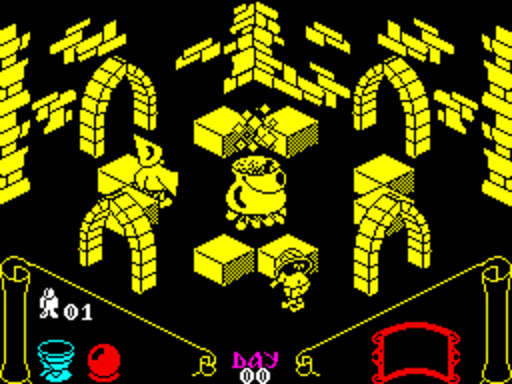 Sabreman returns in an isometric adventure
Knight Lore was the third game in the Sabreman series. This time our hero is suffering from a nasty case of lycanthropy, turning into a werewolf every night as he explores a huge castle seeking a cure. You have 40 days and nights to collect the ingredients the wizard Melkhior needs for his cauldron, and each room of the castle is a puzzle in its own right, with spiked floors, moving blocks and guards to outwit.
A smash at the time, Knight Lore was a huge leap ahead in graphics on the Spectrum and set a standard for other games to follow. Ultimate’s founders, Tim and Chris Stamper, reportedly finished it before Sabre Wulf but held it back because they felt it was too far ahead of anything else on the market. Watching Sabreman transform between man and wolf as the day-night cycle ticked over was a genuine “how did they do that?” moment.
8 – Atic Atac
Ultimate Play the Game – 1983
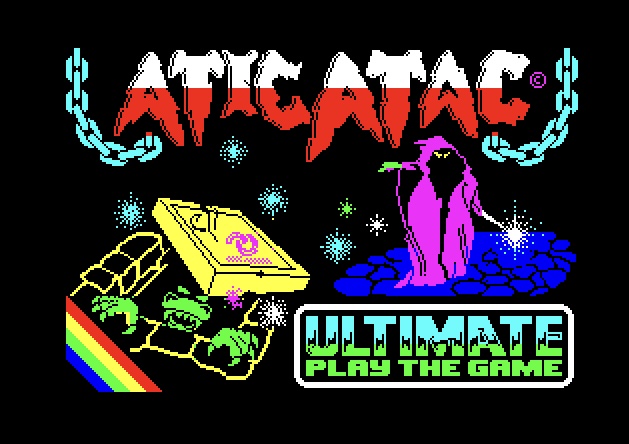
At the time this “haunted castle” game seemed epic, colourful and action-packed like nothing before it on the Spectrum. You play as one of three characters (a knight, a wizard or a serf), each with a different weapon and access to different secret passages through the castle. Find the three pieces of the golden ACG key, avoid or kill the numerous monsters, and fight your way to the exit.
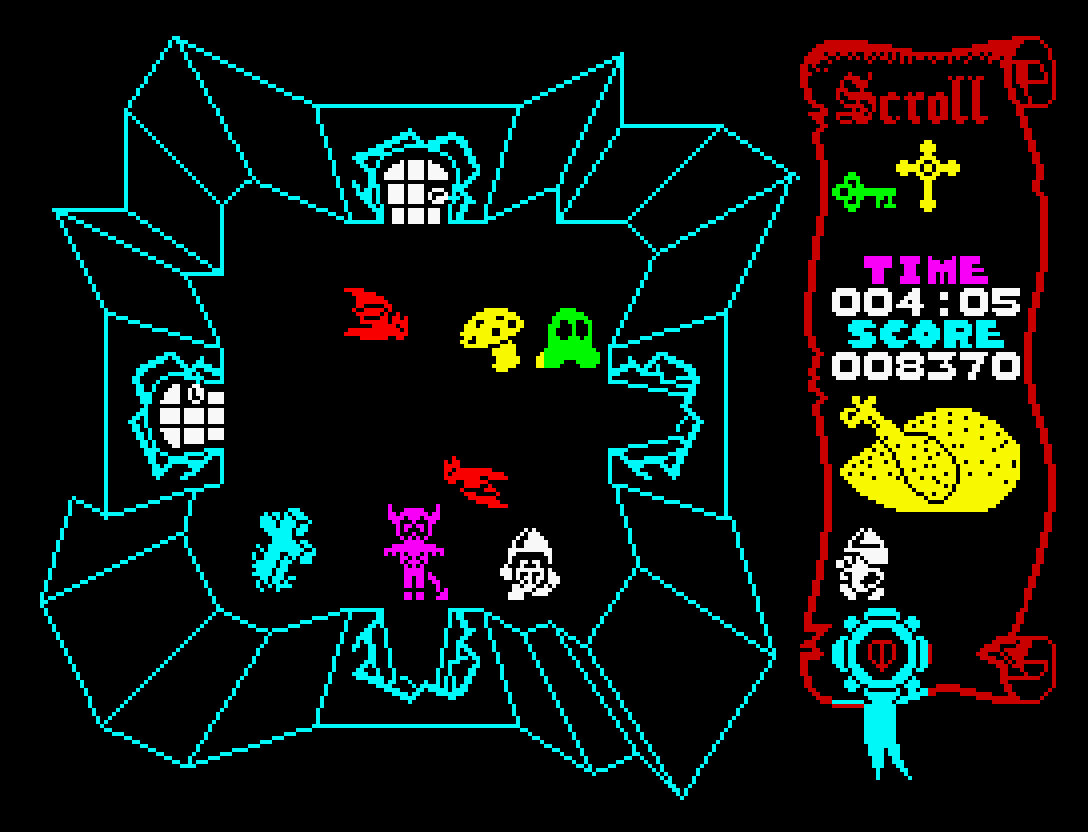 Exploring the basement in Atic Atac
Atic Atac featured some great top-down graphics and well-animated creatures, but my favourite component was the roast-chicken life meter, which slowly gets eaten down to the bone as your character loses health. Food scattered around the castle tops it back up, and the race to find something to eat before the chicken disappears is one of the game’s great tensions.
It was one of many Spectrum games that required you to draw a map as you progressed, often resulting in lots of bits of A4 paper Sellotaped together as your map grew ever larger and more complicated. If you never drew an Atic Atac map, you missed out on a rite of passage.
Read my full review of Atic Atac.
7 – Underwurlde
Ultimate Play the Game – 1984
The sequel to Sabre Wulf, Underwurlde sent our hero Sabreman into an underground world, turning the series on its side to become a platformer rather than a top-down adventure.
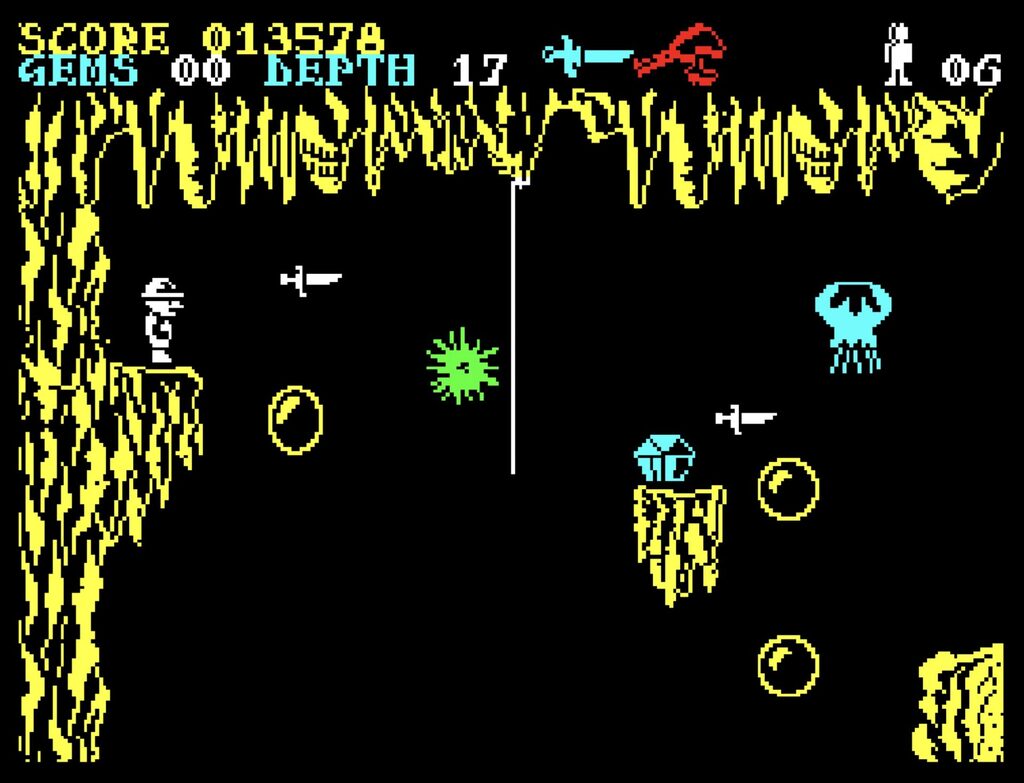 Sabreman is back in Underwurlde
Much like Atic Atac and Sabre Wulf before it, the gameplay required you to explore a complex series of rooms, avoid baddies and find specific items (in this case weapons) in order to defeat the guardians and escape. Along the way Sabreman has to jump gaps, climb ropes and ride on bubbles to traverse a huge maze of over 500 screens. Most of the creatures knock you about rather than killing you outright, which sounds forgiving until one sends you tumbling all the way back down a shaft you have just spent ten minutes climbing.
Some might say three Sabreman games in a Top 10 is too many, but each had a different graphical style and unique gameplay elements that merit their inclusion. Underwurlde is the least celebrated of the three, and I think it deserves more love: it was enormous, beautifully drawn and fiendishly hard.
“…it’s a totally original game that will keep you enthralled for ages”
CRASH! Magazine 1984
6 – Skool Daze
Microsphere – 1984
Another game that could really only have worked in the UK, Skool Daze was the closest thing to a Spectrum version of the popular 80s TV show Grange Hill. You play Eric, whose school report is locked in the staff safe, and your mission is to get the combination out of the teachers before the report reaches home, while surviving everything school throws at you, from grumpy teachers to evil bullies.
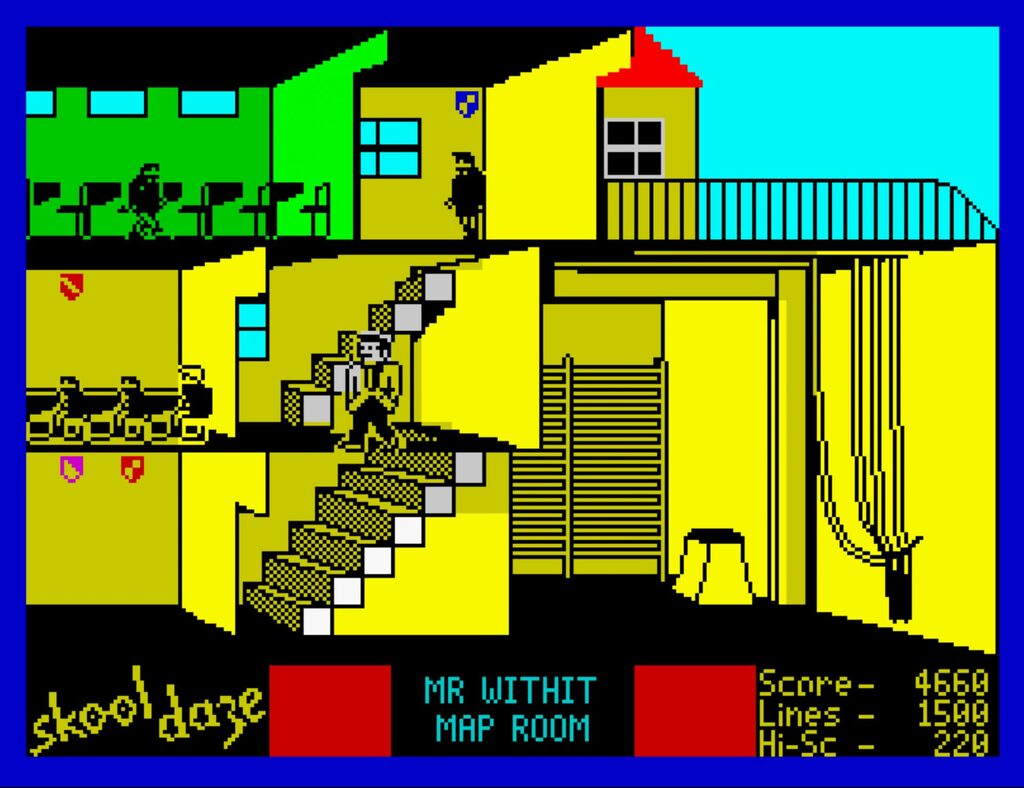 Bunking off in Skool Daze
The school runs to a timetable, and the teachers, swots and bullies all go about their day whether you join in or not. Get caught using your catapult, or any number of other misdemeanours, and you will be given lines; collect 10,000 lines and you are expelled. Better still, you could rename the whole cast at the start, so half the Spectrum owners in Britain played it with their own teachers’ names in the game.
Another game full of classic British humour, it was a unique concept that was platformer, simulation, puzzle and adventure in equal parts, and a firm favourite with many Spectrum owners. Its sequel, Back to Skool, added a girls’ school next door and was every bit as good.
5 – Daley Thompson’s Decathlon
Ocean – 1984
Famous for its ability to destroy joysticks, Daley Thompson’s Decathlon was the Spectrum’s answer to the Track & Field arcade game, requiring players to bash keys and waggle joysticks furiously to make their athlete run, jump and throw their way to victory.
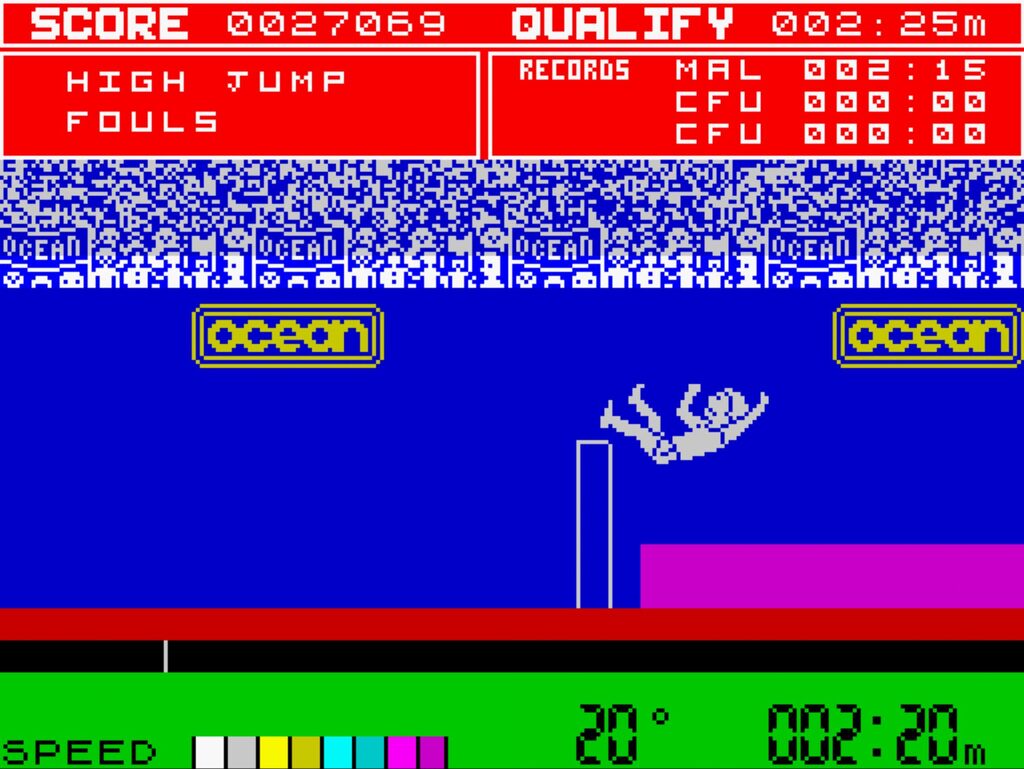 Decathlon – breaking keyboards since 1984
Ocean’s version featured the Olympic decathlete Daley Thompson and gave the player the chance to take part in all 10 events over two days, from the 100 metres and long jump through to the pole vault and the gruelling 1500 metres. The game featured some great animation, although the Olympian himself was rendered as a white sprite, more likely down to the Spectrum’s limited palette and attribute clash than anything else. My personal favourite was the javelin, which required maximum speed and just the right release angle to make a qualifying throw.
Decathlon was a two-player game at heart. Huddled around one keyboard, taking turns to hammer the keys until your fingers hurt, it was one of the great social games of the 8-bit era, and a must for any Spectrum fan’s Top 10.
Read my full review of Daley Thompson’s Decathlon.
4 – Sabre Wulf
Ultimate Play the Game – 1984
The third Ultimate game in my Spectrum Top 10, this was the first outing for Sabreman, who reappears in Underwurlde, in wolf form in Knight Lore and finally as a wizard in Pentagram.
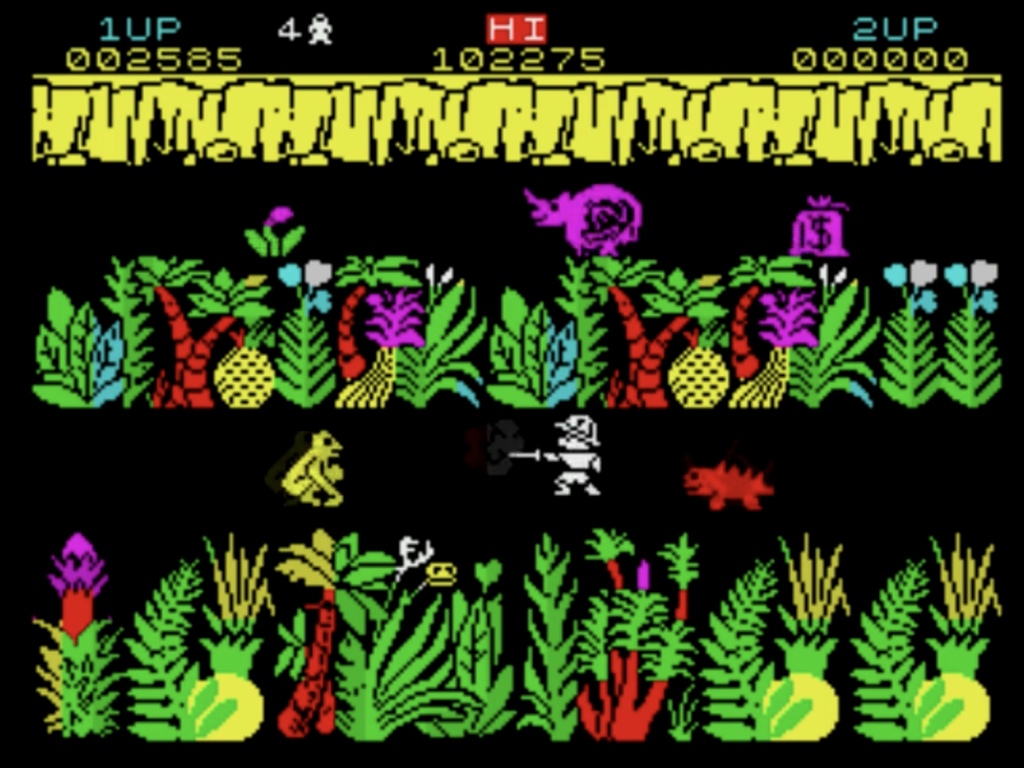 Sabre Wulf ZX Spectrum Screenshot
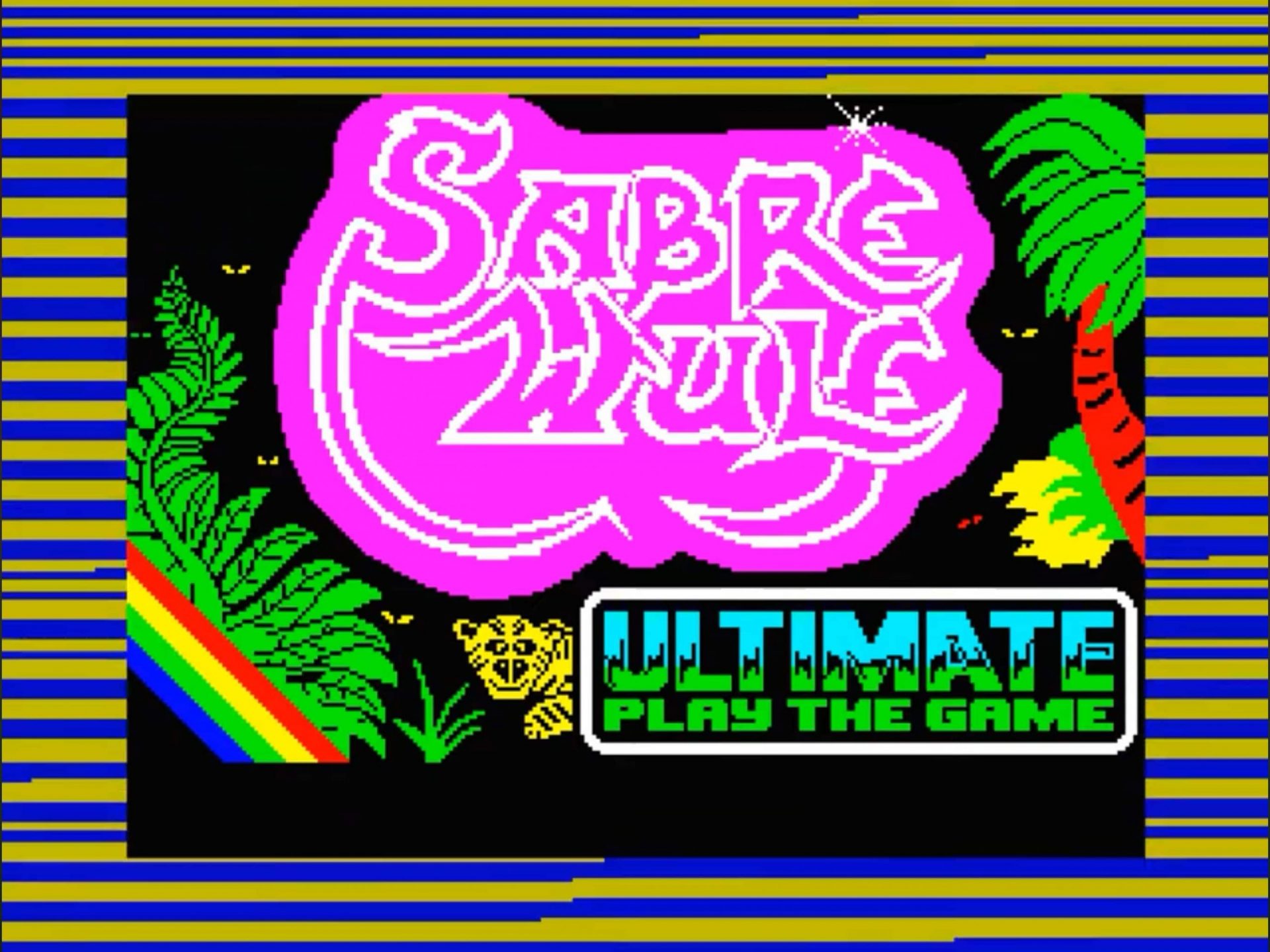
Sabre Wulf was an adventure set in a huge flick-screen jungle maze of lush vegetation, back in the day when there was no map on your heads-up display. If you wanted to find your way through its 256 screens, you had to get busy with a pencil and paper. Avoid the jungle critters, collect the four pieces of the amulet and you were free, but not without a long battle with numerous enemies, a lot of back-tracking, and the occasional run-in with the Sabre Wulf itself. Brightly coloured orchids bloomed around the jungle too, and touching one could make you invincible, confused or faster, depending on its colour.
It launched at £9.95, well above the usual price of a Spectrum game at the time, and came in a big box rather than a cassette case. It sold by the bucketload anyway, which tells you everything about Ultimate’s reputation in 1984. An obvious inclusion in my list of Top 10 Spectrum games.
My full review of Sabre Wulf goes into much more detail.
3 – Everyone’s a Wally
Mikro-Gen – 1985
Mikro-Gen released a much-loved series of platform-adventure games featuring the affable Wally Week on a number of platforms, including the Spectrum. They all featured large, colourful sprites and challenging gameplay, culminating in this version, which let players switch between five members of the Week family and their friends: Wally, Wilma, Tom, Dick and Harry.
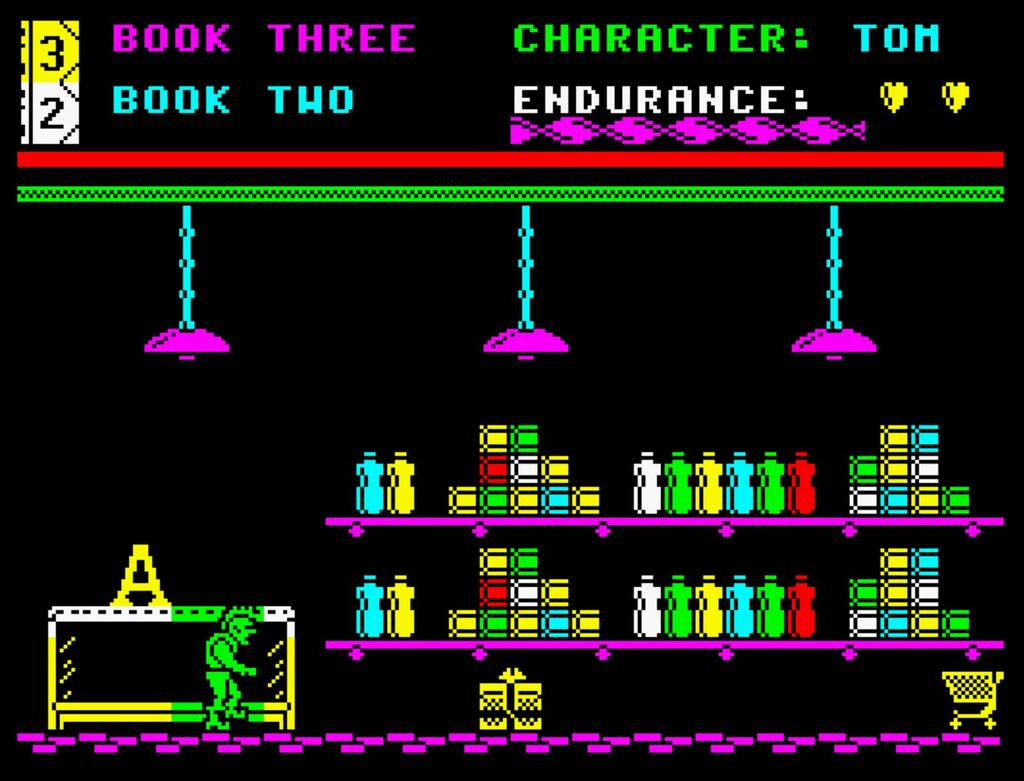 Punk Wally on the prowl
Each character has their own job and special skills, which had to be used to full effect to solve the puzzles needed to complete the game, and each had their own health bar that had to be independently maintained. Working out who needed to carry which object to which part of town, while keeping the rest of the gang out of trouble, made it one of the first games to genuinely feel like a team effort. The cassette even came with a theme song on the B-side.
A novel game with some innovative features, it’s one most Spectrum owners will remember. If you like it, Wally’s earlier adventure is well worth a look too: read my review of Pyjamarama.
2 – 3D Ant Attack
Quicksilva – 1983
Before Ultimate kicked off the craze for isometric adventure games, Quicksilva gave us 3D Ant Attack. Written by Sandy White, it was set in a scrolling isometric 3D city called Antescher (think Zaxxon, with movement in four diagonal directions), and the objective was to rescue your partner, boy or girl depending on your chosen character.
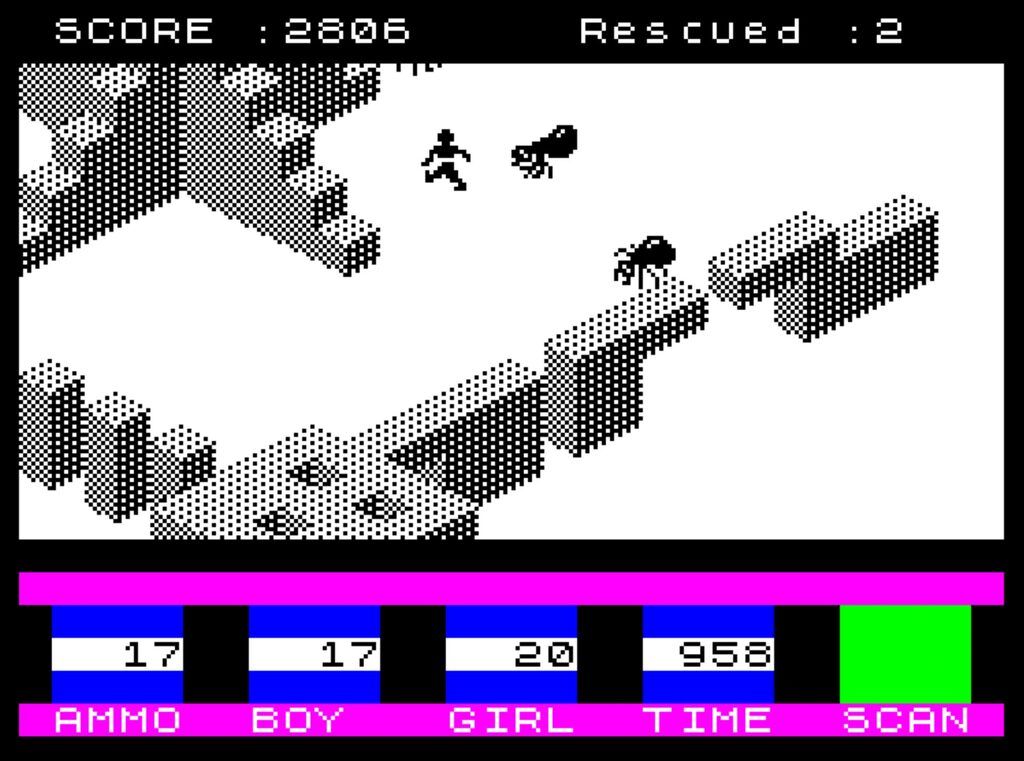 Bloody big ants attacking you
Avoid the giant ants and climb ever more complex structures to locate your mate and escape the city, armed only with a few grenades to stun the overgrown insects. The walled city was a real 3D space you could walk around, climb over and hide in, and the view could be rotated to see behind buildings. In 1983 that was astonishing, and it was one of the very first games to let you choose to play as a girl.
Another unique Spectrum game, it’s a great retro memory for me and still playable today, and you can draw a straight line from Antescher to every isometric game that followed.
1 – Chuckie Egg
A&F Software – 1983
This game was available on a number of platforms and everyone has their favourite, but I loved the Spectrum version. As Hen-House Harry, charged with collecting eggs from a multi-level henhouse, you needed some fairly athletic running and jumping skills to navigate the ladders, platforms and lifts while avoiding the resident hens.
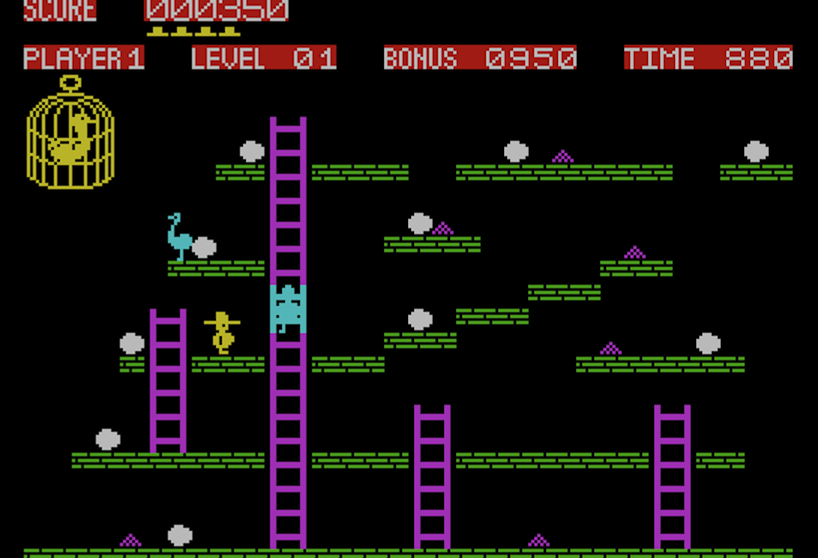 Hen-House Harry plays Chuckie Egg
There are only eight screens, but once you have cleared them they start again with more hens and less time, and on later rounds the giant caged duck at the top of the screen breaks free and hunts you down. The hens stop to eat the piles of seed, which gives you a chance to slip past them, but the bonus timer is always ticking, and the faster the game gets, the more those precise jumps matter.
Frenetic gameplay and excellent controls turned an apparently simple platformer into an enduring Spectrum classic. Written by a teenage Nigel Alderton, it is the perfect example of what made the Spectrum special: one person, one brilliant idea and gameplay that is still fun forty years on. A dead cert for my number one.
Was the Spectrum version really better than the BBC Micro version? Find out in my Chuckie Egg Spectrum vs BBC Micro comparison.
The best Spectrum games that didn’t make the top 10
There were so many exceptional games for the ZX Spectrum that they couldn’t all make it into my top 10. Developers such as Ultimate Play the Game and Ocean produced so many fantastic games that they probably deserve a Top 10 in their own right, and I’ve reviewed several more Ultimate classics, including Tranz Am, Pssst and Bugaboo the Flea from Quicksilva.
Here are some that could easily have made it into the top 10:
- Manic Miner – the original platformer from Matthew Smith, and the first appearance of Miner Willy. But I could only have one Willy in the top 10, and it’s the Jet Set one that pips it.
- JetPac – a classic early Ultimate game best described as a “platform shooter in space”, with slick multi-coloured graphics. It showed what could be achieved with only 16k of memory. Check out my review of JetPac.
- R-Type – an amazing conversion of Irem’s seminal horizontally scrolling arcade shooter, with so much detail that each level had to be loaded separately because it couldn’t all fit in 48k.
- Match Day – Jon Ritman’s football game for Ocean, the go-to two-player game for a generation of Spectrum owners.
- 3D Deathchase – Micromega’s breakneck motorbike chase through a forest, which created a genuine sense of speed on 16k of memory.
- Dizzy – the start of the Codemasters series that kept Spectrum owners puzzling (and spending their pocket money on budget games) well into the 1990s.
I hope this list inspires you to try some of these games for yourself, whether on original hardware or an emulator. They may be 40 years old, but they are still playable today.
The Spectrum was the machine that turned Britain into a nation of gamers and game makers. While Commodore and Acorn owners will make their own cases (see my Top 10 Commodore 64 games and Top 10 BBC Micro games), no other computer had a library this big, this inventive or this full of character. These ten games represent the very best of it.
Frequently Asked Questions
What is the best ZX Spectrum game of all time?
There’s no single answer, and every Spectrum owner has a favourite. Games that regularly top readers’ polls include Jet Set Willy, Knight Lore, Head Over Heels, R-Type and Elite. My own number one is Chuckie Egg, for its perfect controls and pure, simple gameplay.
How many games were made for the ZX Spectrum?
Archives such as ZXDB and the original World of Spectrum catalogue list well over 20,000 Spectrum titles, including commercial releases, budget games, type-in listings from magazines and modern homebrew. It’s one of the largest game libraries of any home computer.
What was the difference between the 16k and 48k Spectrum?
The 16k model had 16 kilobytes of memory and the 48k model had 48. Early games such as JetPac were written to fit the 16k machine, but most later titles needed 48k, so many 16k owners paid to have their machine upgraded. The later Spectrum 128 (1985 in Spain, 1986 in the UK) added more memory and a proper three-channel sound chip.
What is “colour clash” on the Spectrum?
To save memory, the Spectrum stored colour separately from its pixel graphics, allowing only two colours (an ink and a paper colour) in each 8×8 pixel block. When a moving sprite crossed into a block of a different colour, it took on that block’s colours, producing the “attribute clash” that became the Spectrum’s visual trademark. Many developers avoided it by using monochrome play areas, as in Knight Lore.
Why did Spectrum games take so long to load?
Games loaded from ordinary audio cassettes at around 1,500 bits per second, so a full 48k game could take four or five minutes, longer if the tape was stretched or the volume was wrong. Later games used faster “turbo” loaders and loading screens to make the wait more bearable.
Who were Ultimate Play the Game?
Ultimate was founded by brothers Tim and Chris Stamper in Ashby-de-la-Zouch, Leicestershire. Their run of Spectrum hits, including JetPac, Atic Atac, Sabre Wulf and Knight Lore, made them the most celebrated developer on the machine. The Stampers later founded Rare, which went on to make Donkey Kong Country and GoldenEye 007 for Nintendo.
Were Spectrum games better than Commodore 64 games?
This was the source of endless playground arguments! C64 versions usually had better sound and smoother scrolling, while the Spectrum was cheaper, had a bigger library, and its games were often faster and more inventive. Many games came out on both machines, and which version was better varied from game to game. My Top 10 Commodore 64 games gives the other side of the argument.
Can you still play ZX Spectrum games today?
Yes. Free emulators such as Fuse run on Windows, Mac and Linux, and many games can be played in a web browser. For something closer to the real thing, The Spectrum from Retro Games Ltd is a full-size recreation of the original with built-in games, and the ZX Spectrum Next is a modern, expanded Spectrum compatible with original software. Original hardware is still widely available, though old machines often need a little repair work.
Are ZX Spectrum games still being made?
Very much so. The Spectrum has a thriving homebrew scene, with dozens of new games released every year, many of them more technically impressive than anything released commercially in the 1980s. Some are sold on cassette with proper inlays, just like the old days.
What came before the ZX Spectrum?
Sinclair’s previous computer was the ZX81, a black-and-white machine with just 1k of memory as standard. It’s best remembered for 3D Monster Maze, which I’ve reviewed here, and for the infamous wobbly RAM pack.
More like this
Atic Atac Game Review for the ZX Spectrum
Atic Atac was a classic action adventure game for the Sinclair ZX Spectrum by Ultimate Play the Game, one of the first 48k Spectrum titles
Tranz Am Review for the ZX Spectrum
Uncover the retro racing excitement of Tranz Am for ZX Spectrum! Delve into post-apocalyptic challenges and explore open-world racing
Sabre Wulf: ZX Spectrum Classic by Ultimate
Face the dangers of the jungle, unravel secrets, collect amulets & confront the Sabre Wulf in this ZX Spectrum classic
Comments